Thin Seedlings Without Damaging Neighbors
Stage Based Thinning Guide
Recognize seedling stage, mark healthy keepers, choose snipping or a conditional gentle pull, and check root stress with an original printable follow-up record.
FREE · No email or checkout
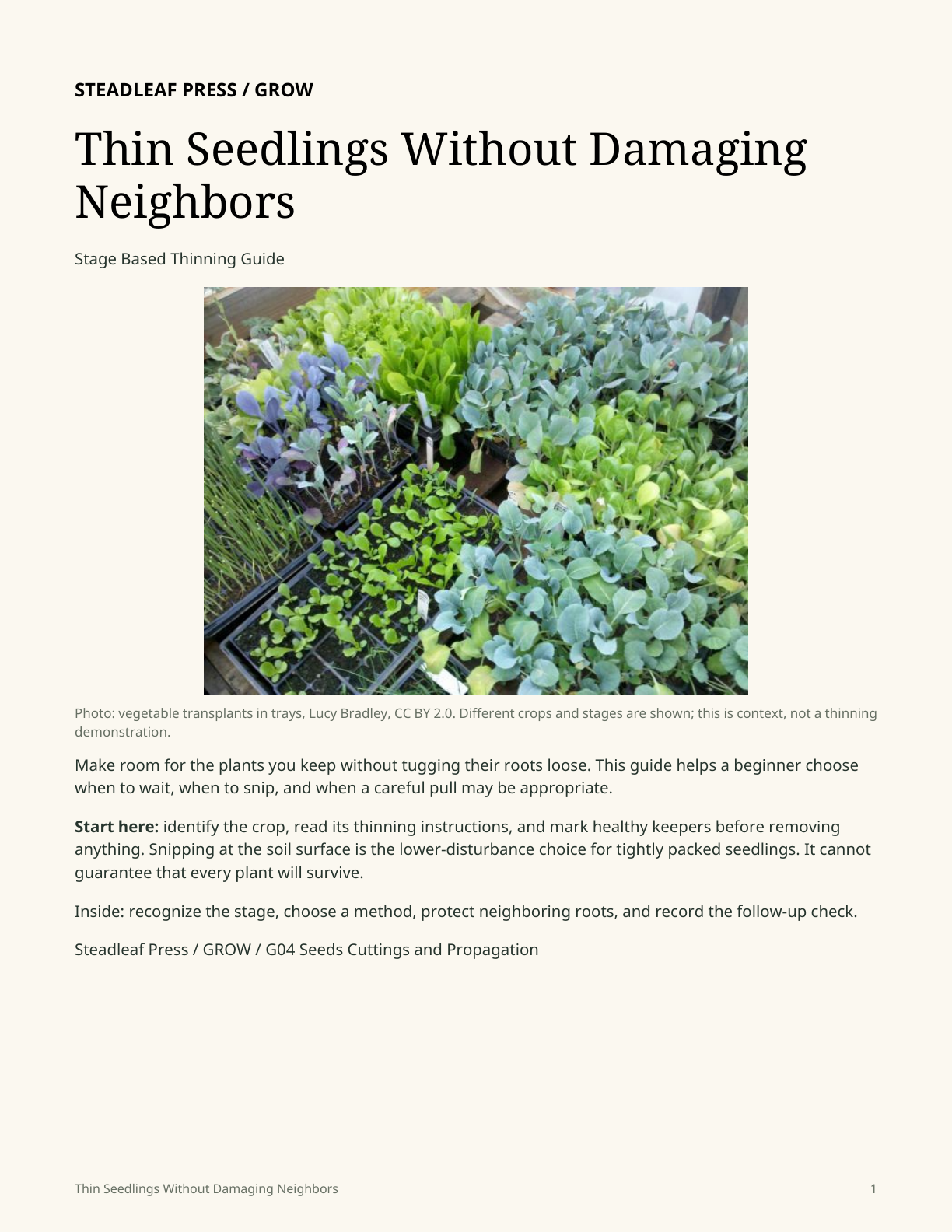
Free practical guide. No email or payment required. The photograph shows seedling and transplant trays at different stages; context, not a thinning demonstration or endorsement.
Read the complete free guide online
Read the instructional text here, or download the complete free PDF above for original diagrams, tables, worksheets and page layout. The original publication is unchanged.
STEADLEAF PRESS / GROW Thin Seedlings Without Damaging Neighbors
Stage Based Thinning Guide
Photo: vegetable transplants in trays, Lucy Bradley, CC BY 2.0. Different crops and stages are shown; this is context, not a thinning demonstration.
Make room for the plants you keep without tugging their roots loose. This guide helps a beginner choose when to wait, when to snip, and when a careful pull may be appropriate.
Start here: identify the crop, read its thinning instructions, and mark healthy keepers before removing anything. Snipping at the soil surface is the lower-disturbance choice for tightly packed seedlings. It cannot guarantee that every plant will survive.
Inside: recognize the stage, choose a method, protect neighboring roots, and record the follow-up check.
Steadleaf Press / GROW / G04 Seeds Cuttings and Propagation
Thin Seedlings Without Damaging Neighbors 1
STEADLEAF PRESS / GROW Stage one Identify before removing
Cotyledons are seed leaves, not the first true leaves. In many broadleaf vegetables, two seed leaves appear before leaves with the plant's more recognizable form. Do not make that a rule for every species: grasses and other monocots have one cotyledon. Count true leaves separately. [1]
Read the plant rather than the calendar
What you notice What it means Your next step
Only seed leaves are open The plant is very young; Confirm the crop and its timing directions. identification or keeper choice may Do not thin the whole batch merely because still be uncertain. the first sprout appeared.
True leaves are developing You can compare growth and Check whether this matches the packet's recognize more crop features. thinning stage; it is not a universal deadline.
Seedlings form a dense Pulling may move several plants Choose snipping if you can see individual tangle together. stems safely. Do not pull a handful apart.
Mark the seedling to keep with a nearby label, not a tie around its stem. Look for healthy, sturdy growth and an intact stem base. The tallest plant is not necessarily the strongest; a long, weak stem is not an advantage. [3]
Pause if identity is unclear. A mixed row may contain deliberately sown marker crops as well as weeds. Verify what you are removing; do not use this guide to identify edible plants.
Thin Seedlings Without Damaging Neighbors 2
STEADLEAF PRESS / GROW Stage two Set the target
The seed packet's final plant spacing is different from the spacing used to sow extra seeds. Record the variety, intended harvest and growing method. Measure the gap from one retained stem to the next, not between leaf tips. Check row spacing separately. [4]
Three situations that need different decisions
Growing situation Timing and target
Several seedlings in a cell intended for one transplant UMN recommends cutting all but the healthiest once true leaves develop. That is cell guidance, not the final outdoor distance between mature plants. [2]
Direct sown carrots Iowa State gives a crop-specific example: thin at 3 to 4 inches tall, leaving 2 to 4 inches between plants, and cut rather than pull. Use your variety's instructions; do not transfer these numbers to another crop. [5]
A planned group or multiseed sowing Confirm the intended plants per group and distance between groups. Do not automatically reduce every deliberate group to one plant. Some onion methods intentionally retain several seedlings. [8]
Where a packet prescribes several thinning passes, write down each stage and target. If it gives no stage or conflicts with local crop guidance, ask the supplier or Extension service before removing a large share of the stand. Do not average contradictory numbers.
Choose keepers across the whole short section first. Avoid removing a healthy plant and only then noticing that the next usable keeper is far away. A gap is preferable to saving a visibly collapsing plant just to fill a measurement.
Thin Seedlings Without Damaging Neighbors 3
STEADLEAF PRESS / GROW Stage three Snip crowded seedlings
Snipping is especially useful in a shared cell, a closely packed row, or a cluster whose roots are likely entangled. It removes the shoot without deliberately extracting its root system. UMN recommends this for shared cells; Ohio State also uses scissor thinning when roots intertwine. [2,3]
Work one stem at a time
1. Prepare clean, sharp, small scissors and enough light to see the stem base. Put the tray on a stable surface; keep fingers clear of the blades.
2. Check moisture. Work with damp, drained mix or soil, not a saturated tray or sticky mud. If dry, moisten gently and let excess water drain before starting. [2,3]
3. Identify the keeper again. Trace the unwanted plant down to its own stem; overlapping leaves can be misleading.
4. Place the blades at the unwanted stem's soil-level base, clear of the keeper and your fingers. Cut that stem only. Do not push the blades below the surface to chase a root.
5. Lift away the severed top without dragging it through neighboring plants. Leave the cut roots in place rather than tugging them out.
If the gap is too tight to see a safe cutting path, stop and reposition the tray or your hands. Do not make a blind cut through a cluster. This is thinning, not a reason to trim the keeper's roots or leaves.
Check the retained plant after each cut. The stem should still be intact and its position unchanged. Recheck any cut stump later; if it resprouts, reassess the crop and remove renewed competition carefully rather than assuming one cut always finishes the job.
Thin Seedlings Without Damaging Neighbors 4
STEADLEAF PRESS / GROW Stage four Pull only when suitable
A selective pull is an option for small, well-separated seedlings in moist soil when crop guidance permits it. It is not the default for a crowded shared cell. Purdue advises switching to cutting if pulling damages neighboring plants. [4]
Try one unwanted plant first. Hold it close to the soil surface and ease it out gently. Watch the soil and the keeper, not just the plant in your hand. If the keeper lifts, tilts, or the soil moves as one clump, stop pulling. Do not increase force or tease the intertwined roots apart to complete the pull.
Gently settle loosened soil around the retained plant without crushing its stem or packing the bed hard. Water gently as needed to settle disturbed soil; do not leave the container standing in water. [2,4]
Exceptions worth checking
Carrots and parsnips: Iowa State recommends direct sowing and cutting unwanted seedlings because transplanting and soil disturbance can damage these root crops. Do not save the thinnings by routinely replanting them. [5]
Beet clusters: one seedball may produce several seedlings. A cluster is not proof that you accidentally dropped many seeds. Follow the spacing for the variety and harvest goal rather than keeping every shoot. [6]
Seedlings intended for transplanting: pricking out is a separate operation with root support and new pots ready. It is not interchangeable with yanking out thinnings. Not every removed seedling is suitable for reuse.
This guide does not recommend eating thinnings. Plant identity, seed treatment and growing conditions need their own food-safety assessment.
Thin Seedlings Without Damaging Neighbors 5
STEADLEAF PRESS / GROW Stage five Watch the keepers
Finish with a short inspection rather than a heavy watering or fertilizer treatment. Look for a cut stem, exposed roots, a lifted plant, or soil pulled away from its base. Record any disturbance and stop work on that section if the keepers are moving. Recheck later and at the next daily inspection
What you notice What to do next
Upright plants and stable soil Continue normal crop care. Check the next planned thinning stage and final spacing.
Wilting after the work Pause further thinning. Check moisture below the surface and drainage before watering. Wilt alone does not tell you whether roots are too dry, too wet or injured.
A keeper was lifted or roots exposed Gently restore soil contact at the original level. Avoid repeatedly lifting it to inspect the roots. Seek crop-specific help if it does not recover.
A pinched or rotting stem base and collapse Do not keep it as the best plant or assume extra water will fix it. Suspect a seedling disease and seek identification. [7]
Damping off can kill young seedlings; infected seedlings rarely become vigorous plants. Damp, cool conditions and poor drainage can favor it. Thinning does not cure infected plants. Remove diseased material and follow Extension guidance on sanitation and the growing environment. [7] Keep normal light and temperature conditions appropriate for the crop. Thinning is not hardening off: do not suddenly move indoor seedlings into exposed outdoor sun or wind. [2] Your stopping rule: finish only the section you can work without disturbing keepers. Record the rest as pending; do not rush through a struggling tray to meet a date.
Thin Seedlings Without Damaging Neighbors 6
STEADLEAF PRESS / GROW My thinning plan and follow up
Crop and variety _____________________ Sown on _____________________ Location or tray _____________________ Checked on __________________ Packet or crop guidance used _________________________________________
Decision to record My notes
Current stage and thinning trigger __________________________________ __________________________________
Final spacing or plants per cell or group __________________________________ __________________________________
Keepers chosen and why __________________________________ __________________________________
Method and safe access to stems __________________________________ __________________________________
Section finished and next check __________________________________ __________________________________
Before starting: crop confirmed ___ healthy keepers marked ___ soil damp and drained ___ clear cutting path ___ Afterward: stems intact ___ soil stable ___ spacing checked ___ remaining work noted ___ Later check and any change ___________________________________________ ___________________________________________________________________ If I see lifting, tilting or collapse I will stop and _______________________ ___________________________________________________________________
Thin Seedlings Without Damaging Neighbors 7
STEADLEAF PRESS / GROW Sources and photo credit
Primary horticultural guidance checked 2 November 2026. The work sequence and printable record are Steadleaf's practical synthesis; crop-specific instructions take priority over a generic stage or spacing rule.
1. NC State Extension Gardener Handbook Propagation. Seed leaves, true leaves and cotyledon differences.
2. University of Minnesota Starting seeds indoors. Shared-cell snipping, drainage, handling and acclimation.
3. Ohio State Farm to School Thinning indoor and outdoor plants. Stocky keepers, moist soil and scissor thinning.
4. Purdue Home Gardeners Guide. Small seedlings, conditional pulling, spacing and resettling soil.
5. Iowa State Growing carrots and parsnips. Crop-specific timing, spacing and cutting instead of pulling.
6. University of Maryland Growing beets. Multigerm seedballs and variety-dependent thinning.
7. University of Minnesota Prevent seedling damping off. Symptoms, sanitation and moisture management.
8. South Dakota State Onions. Intentional clump planting is a specific method, not accidental crowding.
Photo: Lucy Bradley, Transplants, Figure 16-19 in NC State Vegetable Gardening, CC BY 2.0. Full frame proportionally resized and JPEG encoded for this edition. No endorsement implied. No additional restrictions on the licensed photograph.