Use Pot Weight to Judge Drying
Learn the feel of one familiar pot.
Establish watered-and-drained and independently confirmed ready-to-water references, compare a consistent assembly and record weight feel beside a separate mix cue.
FREE · No email or checkout
Free practical guide. No email or payment required. Photos are contextual illustrations, not proof of measured conditions or physical trials.
Read the complete free guide online
Read the instructional text here, or download the complete free PDF above for original diagrams, tables, worksheets and page layout. The original publication is unchanged.
STEADLEAF PRESS / GROW Use Pot Weight to Judge Drying
Learn the feel of one familiar pot.
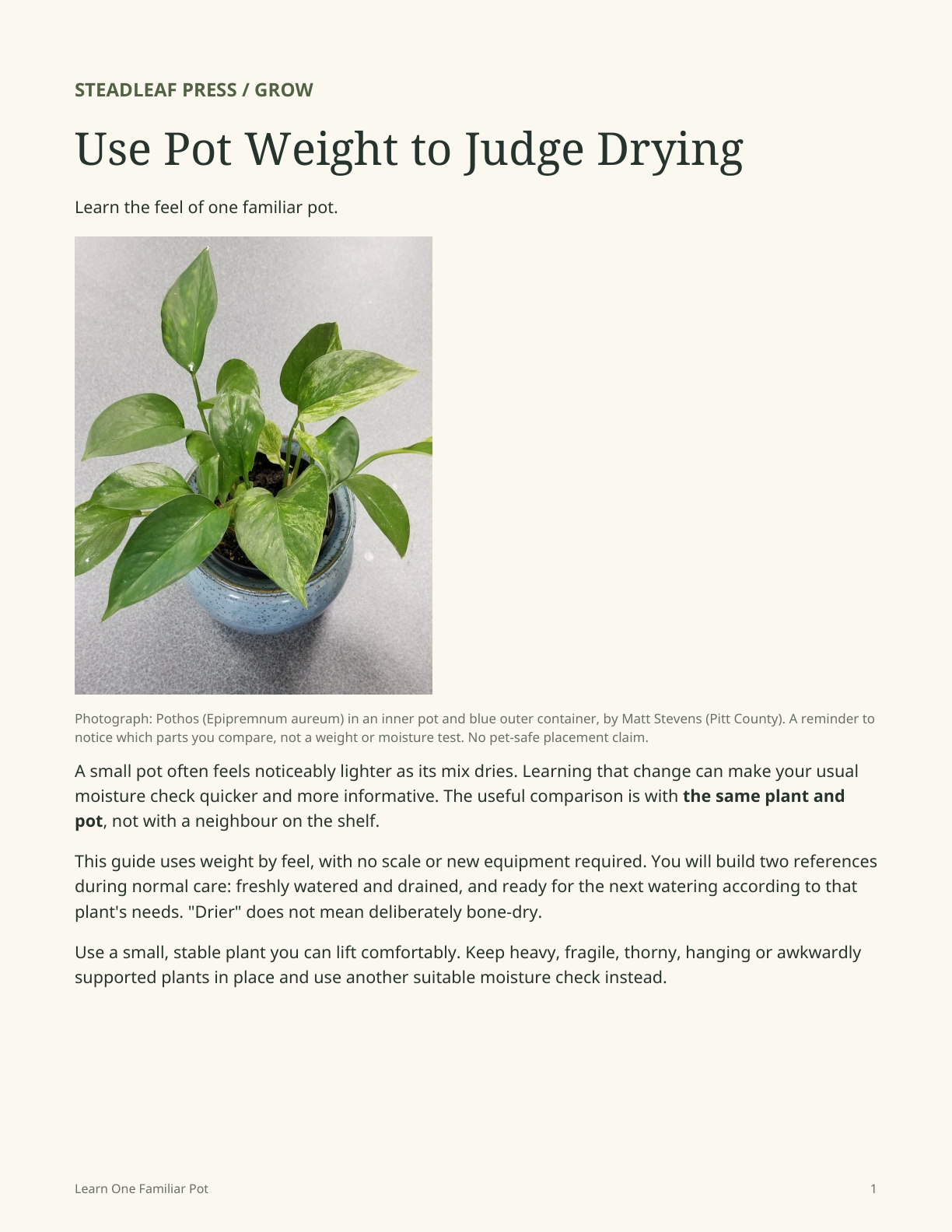
Photograph: Pothos (Epipremnum aureum) in an inner pot and blue outer container, by Matt Stevens (Pitt County). A reminder to notice which parts you compare, not a weight or moisture test. No pet-safe placement claim.
A small pot often feels noticeably lighter as its mix dries. Learning that change can make your usual moisture check quicker and more informative. The useful comparison is with the same plant and pot, not with a neighbour on the shelf.
This guide uses weight by feel, with no scale or new equipment required. You will build two references during normal care: freshly watered and drained, and ready for the next watering according to that plant's needs. "Drier" does not mean deliberately bone-dry.
Use a small, stable plant you can lift comfortably. Keep heavy, fragile, thorny, hanging or awkwardly supported plants in place and use another suitable moisture check instead.
Learn One Familiar Pot 1
STEADLEAF PRESS / GROW Choose what you will lift
Keep the comparison consistent
Decide which parts belong in every check: the plant, its growing pot, mix and any support that stays attached. Write them down. An outer decorative pot, a wet saucer or a newly added stake changes the weight even if the mix has not changed.
Where a small nursery pot lifts out safely, comparing that growing pot alone can make the change easier to notice. Use the same arrangement each time. Do not force a tight-fitting pot out or remove supports merely to create a cleaner comparison.
If the assembly cannot stay consistent, record what changed and treat the old comparison cautiously. The aim is a helpful habit, not a perfect measurement.
Try a comfortable, low lift
Set up over a clear, stable surface. Support the pot securely, including its base, and lift only enough to feel its weight; then set it back down gently. Hold the container, not stems, leaves or a plant stake. Skip the lift if your grip or balance is uncertain.
Keep the outside of the pot dry enough to grip. After handling, wash your hands. Nothing needs to be unpotted for this exercise.
My comparison assembly: __________________________________
Parts excluded every time: _________________________________
My usual plant-specific moisture check: ______________________
Learn One Familiar Pot 2
STEADLEAF PRESS / GROW Build two useful references
Maryland Extension describes lifting the plant and pot to notice weight change. Purdue likewise identifies weight as a useful indicator for small plants. Pair this clue with the mix's condition rather than using weight alone. [1, 2]
Reference A: watered and drained
At a watering the plant actually needs, water appropriately and allow excess water to drain. Empty the collection saucer. Once the pot is no longer dripping and can be handled safely, feel the weight of your chosen assembly and record it. [1]
This is your watered-and-drained reference, not a pot left soaking in water. You do not need to add extra water to make it maximally heavy.
Reference B: ready for normal watering
As the plant goes through its ordinary drying cycle, compare its weight with Reference A and perform your usual moisture check. When that independent check and the species' needs indicate it is time to water, note the weight feel before watering normally.
This is your ready-to-water reference. Do not delay care until the plant wilts, the mix shrinks away or the pot becomes as light as possible. Purdue advises watering before wilting; different plants need different degrees of drying. [2]
Learn again over the next normal cycle
Repeat the comparison during normal care. Look for a recognizable pattern, not an identical number of days. If the feel is hard to distinguish, keep the mix check as your main tool. Iowa State notes that weight judgement is subjective and that a growing plant becomes heavier over time. [3]
Learn One Familiar Pot 3
STEADLEAF PRESS / GROW Put the clues together
Weight clue Mix or care clue Sensible next step
Similar to the watered-and-drained Mix is still appropriately moist Wait on watering; observe again as reference part of normal care.
Noticeably lighter than that Mix has not yet reached this plant's Continue observing. Lighter does reference watering point not automatically mean thirsty.
Similar to the ready-to-water Independent moisture check also Water normally and refresh the reference indicates watering is due drained reference afterwards.
Lighter, but the mix seems wet; or The clues disagree Recheck the assembly, collection heavy, but accessible mix seems dry water and accessible mix. Investigate rather than automatically adding water.
The plant, pot, mix or support has Old references no longer compare Start fresh references during changed like with like appropriate normal care.
An example of useful notes
Invented example: "After normal watering and drainage: clearly heavier. Later check: lighter, but accessible mix still moist enough for this plant, so I waited. At the next check, the plant-specific moisture cue said water was due; I recorded that lighter feel, watered and let it drain."
The example deliberately has no day count or weight percentage. Your hand is noticing a trend, not measuring how much usable water remains at every depth.
If a plant is declining: a weight clue cannot diagnose the cause. Wilting can occur with wet as well as dry conditions. Check the broader care picture and seek plant-specific help when needed. [1, 3]
Learn One Familiar Pot 4
STEADLEAF PRESS / GROW Your wet-to-ready weight log
Plant / pot: ________________________ Started: _______________
Assembly kept the same: _____________________________________
Species-specific watering cue and source: _______________________
Use plain words such as "heavier", "similar", "lighter" or "hard to tell". A blank entry is better than guessing. Record the mix cue separately.
Date / cycle Weight feel Independent mix cue Action / changes
Cycle 1: drained ______________ ______________ ______________
Between ______________ ______________ ______________
Cycle 1: ready ______________ ______________ ______________
Cycle 2: drained ______________ ______________ ______________
Between ______________ ______________ ______________
Cycle 2: ready ______________ ______________ ______________
What I can recognize now: _________________________________
___________________________________________________________
What needs a fresh reference? Repotting, a changed mix or pot, added or removed supports, substantial growth or pruning, or a change in which parts you lift. Record the change rather than forcing the old pattern to fit. [3; editorial application]
Learn One Familiar Pot 5
STEADLEAF PRESS / GROW Sources and photograph
Primary guidance checked 2 November 2026. The paired references and log are original editorial tools for qualitative observation, not a calibrated moisture test. No plant was dried or weighed to produce this guide.
1. University of Maryland Extension, Watering Indoor Plants. Pot-weight change alongside other watering cues; drainage and symptom ambiguity. Only these sections are used here. https://extension.umd.edu/resource/watering-indoor-plants
2. B. Rosie Lerner, Purdue Extension, HO-39: Indoor Plant Care. Small-plant weight comparison and watering before wilting. Universal depths, fertilizer recipes and other unrelated instructions are not adopted. https://ag.purdue.edu/department/hla/extension/extension-publications-library/ext-pubs/ho-39-w.html
3. Randall Vos, Iowa State University Extension, Watering Plants in Containers and Plug Trays. Subjective weight judgement, changing plant mass and combining observations. The greenhouse moisture-level scale is not reproduced. https://yardandgarden.extension.iastate.edu/article/2025/04/watering-plants-containers-and-plug-trays
Photo credit: Matt Stevens (Pitt County), "Epipremnum aureum (Pothos) houseplant view", image 40476. Source: NC State Extension Gardener Plant Toolbox. https://plants.ces.ncsu.edu/plants/epipremnum-aureum/
Licence: CC BY 4.0. https://creativecommons.org/licenses/by/4.0/ Full frame proportionally resized and encoded; source rendition retained unchanged. No generated or retouched plant details. Hidden drainage and this specimen's weight or water needs are not inferred.