Water a Deep Pot Evenly Without Flooding It
Give the water time to find the mix.
Perform a gentle staged watering event, interpret surface and runoff behaviour, stop at appropriate checkpoints and record what remains uncertain.
FREE · No email or checkout
Free practical guide. No email or payment required. Photos are contextual illustrations, not proof of measured conditions or physical trials.
Read the complete free guide online
Read the instructional text here, or download the complete free PDF above for original diagrams, tables, worksheets and page layout. The original publication is unchanged.
STEADLEAF PRESS / GROW Water a Deep Pot Evenly Without Flooding It
Give the water time to find the mix.
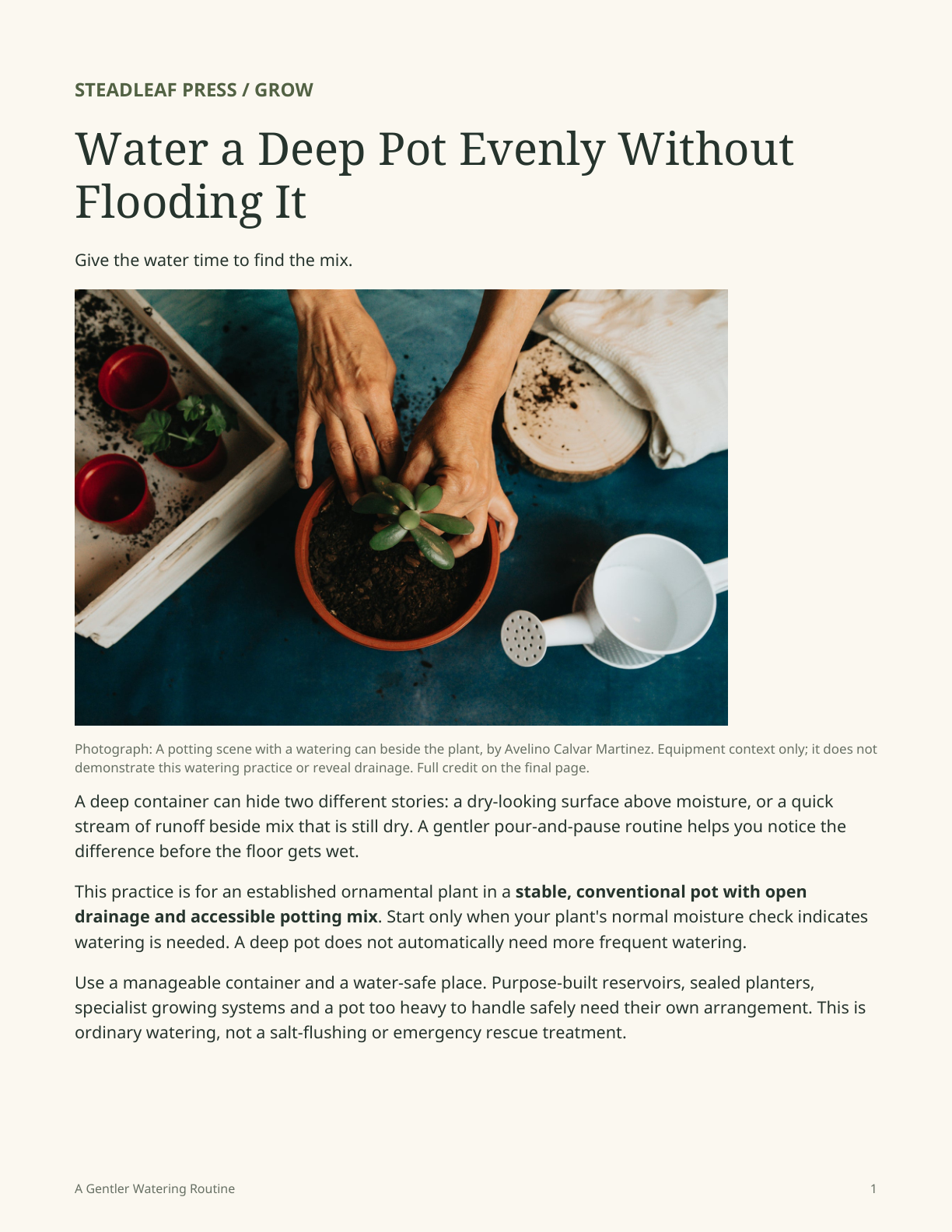
Photograph: A potting scene with a watering can beside the plant, by Avelino Calvar Martinez. Equipment context only; it does not demonstrate this watering practice or reveal drainage. Full credit on the final page.
A deep container can hide two different stories: a dry-looking surface above moisture, or a quick stream of runoff beside mix that is still dry. A gentler pour-and-pause routine helps you notice the difference before the floor gets wet.
This practice is for an established ornamental plant in a stable, conventional pot with open drainage and accessible potting mix. Start only when your plant's normal moisture check indicates watering is needed. A deep pot does not automatically need more frequent watering.
Use a manageable container and a water-safe place. Purpose-built reservoirs, sealed planters, specialist growing systems and a pot too heavy to handle safely need their own arrangement. This is ordinary watering, not a salt-flushing or emergency rescue treatment.
A Gentler Watering Routine 1
STEADLEAF PRESS / GROW Set up a calm watering station
Make room for the water that leaves
Use a suitable draining station or a stable waterproof catchment you can inspect and empty without lifting a heavy wet pot. Keep the base drainage openings clear. Protect furniture and keep water away from electrics, food preparation and walking routes.
Check the collection space before starting. A shallow saucer can overflow well before a large pot has finished draining. If you cannot safely manage the runoff, improve the arrangement first rather than hoping the saucer will hold it all.
Make the pour easy to control
Fill a small watering can or jug only to a comfortable carrying weight. RHS recommends lighter trips rather than struggling with a heavy can. Use a gentle stream close to the mix, below the foliage, so you can spread water without washing material over the rim. [1]
Look for clear places to aim between stems and the pot edge. Leave leaves and crowns undisturbed; do not force the spout into a crowded root ball. If you cannot reach the mix safely, choose a more suitable method with plant-specific guidance.
Before you pour: Why does this plant need water today? __________
Where will runoff go? ________________________________________
How will I empty the catchment safely? __________________________
A Gentler Watering Routine 2
STEADLEAF PRESS / GROW Pour, pause, look again
Think of a watering event as several opportunities to observe, not a race to empty the can. Slow applications can help dry mix take up water. [1, 2, 3]
1. Begin across the accessible surface
Direct a gentle pour onto the mix, moving among the clear spaces around the plant. Avoid concentrating the whole pour at one edge. Aim for broad coverage, not a forceful jet down one channel.
2. Pause while it enters the mix
Stop pouring before water threatens to cross the rim. Let any brief surface puddle sink in. Watch both the surface and the collection area. The pause is guided by what happens in this pot, not a fixed number of seconds.
3. Continue only as the observations support it
If water is entering the mix normally, the catchment has capacity and no drainage has appeared yet, another gentle pass can extend the wetting. If water remains pooled, escapes over the rim or rapidly runs down an edge, stop and use the comparison on the next page.
4. Treat drainage as a checkpoint
At the first ordinary drainage, pause the pour and reassess. RHS advises stopping at or just before drainage appears; Iowa State describes watering until it begins. Neither is a reason to keep a continuous stream running through the pot. [1, 4]
5. Finish with a local check and clear catchment
After water has had a chance to enter and drain, gently compare accessible mix at more than one spot using your usual plant-appropriate moisture check. If a spot is still clearly dry and the pot is draining normally, a further small, slow application may help. Stop if repeated passes still bypass the mix. [2, 3]
Allow excess water to drain, then remove collected water safely. Check again for later drips before returning a movable pot to its place. Do not leave an ordinary pot standing in a bath. [3]
A Gentler Watering Routine 3
STEADLEAF PRESS / GROW Read what the water is doing
What you observe What it may mean Your next move
Surface wets gradually; water The pour is reaching accessible mix Continue slowly while watching the enters without spilling catchment; pause at drainage.
Water crosses the rim or washes The delivery is outrunning entry or Stop. Let the surface settle; use a mix away available rim space gentler pour only if watering is still appropriate.
Immediate runoff beside a visible Water may be bypassing shrunken Pause and check accessible mix. gap at the wall dry mix Several slow applications may help; persistent bypass needs a different rewetting plan.
Pooling persists and expected Entry or the drainage route may be Stop adding water. Assess the drainage is absent restricted container and mix rather than trying to force flow.
Draining appears normal but Wetting may be uneven Recheck gently; direct any justified accessible spots differ further slow pass to dry accessible areas, not a continuous flush.
The deep-pot limit: Runoff proves that some water found a route out. It does not prove the whole root zone is evenly moist. A shallow touch check also cannot certify the bottom of a deep pot. Keep that uncertainty in your notes; do not dig, invert the plant or drive a probe through roots to remove it.
Dry mix can pull away from the container wall, allowing water to escape while much of the mix remains dry. Iowa State and Maryland describe this problem. If ordinary staged watering does not improve it, seek a suitable rehydration method for that plant and container instead of adding unlimited water. [3, 4]
A Gentler Watering Routine 4
STEADLEAF PRESS / GROW One session, a more useful note
Use this card during a watering your plant already needs. Record observations, not a target volume. Optional amounts describe this event only; they are not a recipe for the next one.
Plant / pot: __________________________ Date: ________________
Reason for watering today: ___________________________________
Stage Surface and drainage Action taken observations
Before pouring ____________________ ____________________
First gentle pass ____________________ ____________________
Pause / first drainage ____________________ ____________________
Local check / any further pass ____________________ ____________________
After draining and emptying ____________________ ____________________
Areas checked and what remains uncertain: _____________________
___________________________________________________________
Next observation reminder: ___________________________________
Next time: Check actual moisture again. Weather, plant growth, mix and container size influence drying; today's successful routine does not establish a fixed schedule. [4]
A Gentler Watering Routine 5
STEADLEAF PRESS / GROW Sources and photograph
Primary guidance checked 2 November 2026. The staged practice and observation card are original editorial synthesis. No measured wetting profile, fixed water volume or physical trial is claimed.
1. RHS, How to water containers. Slow close-to-mix pouring, manageable can weight, pauses and drainage stopping point. https://www.rhs.org.uk/container-gardening/how-to-water-containers
2. Kristopher S. Criscione and Ashton Holliday-Goulart, Virginia Cooperative Extension, Virginia Tech and Virginia State University, Properly Watering Container Houseplants, SPES-804P. Dry-mix water repellence, staged applications and local checks; inversion and rigid quantities are not adopted here. https://www.pubs.ext.vt.edu/SPES/spes-804.html
3. University of Maryland Extension, Drought Stress to Indoor Plants. Repeated applications for shrunken dry mix and removal of saucer water. https://www.extension.umd.edu/resource/drought-stress-indoor-plants
4. Iowa State University Extension, Care of Plants Growing in Containers. Drainage checkpoint, bypass of dry shrunken mix and variable watering needs. https://yardandgarden.extension.iastate.edu/how-to/care-plants-growing-containers
Photo credit: Avelino Calvar Martinez, "A Small Plant Into A Red Pot With Watering Can", Burst by Shopify. https://www.shopify.com/stock-photos/photos/a-small-plant-into-a-red-pot-with-watering-can
Licence: Burst Photo License. https://www.shopify.com/stock-photos/licenses/shopify-some-rights-reserved Full frame proportionally resized and encoded for this free guide. Retained source rendition unchanged; no generated or retouched plant details, measurement or process-proof claim.