Find Winter Light Changes in One Room
Four gentle weekly check-ins can help you see your room differently.
Keep a manageable four-week two-position record, distinguish observed and unknown intervals, and choose to keep a position, consider an alternative or gather a fairer comparison.
FREE · No email or checkout
Free practical guide. No email or payment required. Photos are contextual illustrations, not proof of measured conditions or physical trials.
Read the complete free guide online
Read the instructional text here, or download the complete free PDF above for original diagrams, tables, worksheets and page layout. The original publication is unchanged.
STEADLEAF PRESS / GROW Find Winter Light Changes in One Room
Four gentle weekly check-ins can help you see your room differently.
The patch of sun beside a favourite chair may shift long before you notice a change in a plant. Winter is a useful time to look again: not to chase the brightest corner every day, but to understand what your familiar room is doing.
Choose two fixed positions, make a few observations each week and keep the weather and curtains in the story. At the end, you will have a four-week location record and a reason to keep a plant where it is, consider another position or collect better evidence.
This is a blank observation workbook, not a completed experiment. Four weeks can reveal a local pattern; they cannot measure a whole winter's light or prove what caused every change. You do not need to buy a meter, install an app or put a plant in an unsuitable place to begin.
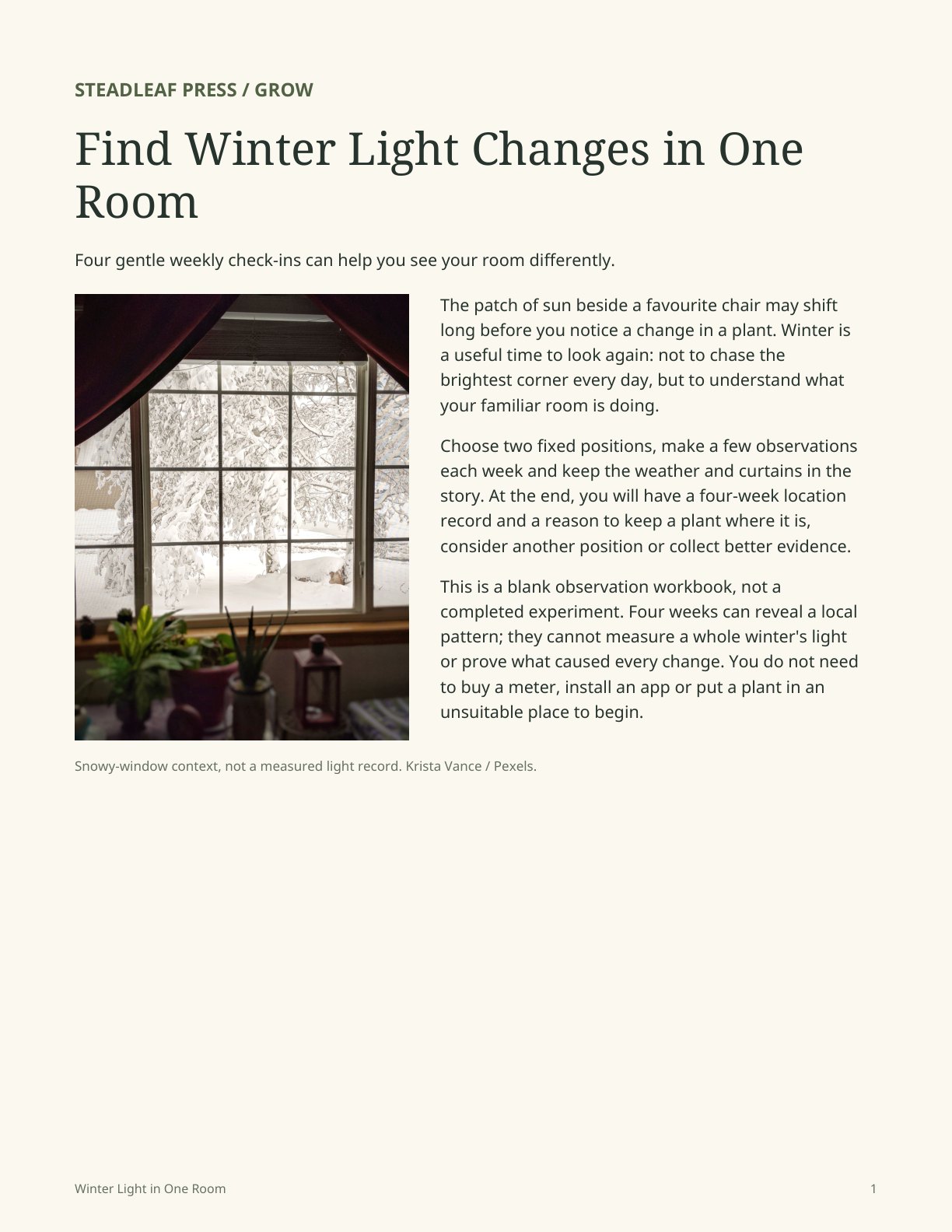
Snowy-window context, not a measured light record. Krista Vance / Pexels.
Winter Light in One Room 1
STEADLEAF PRESS / GROW Winter can change the shape of light
Shorter days do not mean that every indoor position receives less direct sun. A lower winter sun can pass beneath an overhang or reach farther into a room, while another location may become shaded by a neighbouring building. Leaf loss on deciduous trees can change the view of the sky. The direction, size and surroundings of your window all matter. [1]
Use your local winter, not a fixed set of calendar months. The Northern and Southern Hemispheres have opposite seasons, and tropical or high-latitude conditions need local interpretation. Australian guidance describes substantial winter solar access through north-facing windows; that is a useful reminder not to turn one region's window rules into a worldwide rule. [2,6]
Around the local winter solstice, daylight may change only a little; after it, days begin to lengthen. A four-week record need not show a steady decline. [6]
Weather adds another layer. A cloudy check and a clear check do not isolate a seasonal change. Nor do a newly opened blind, a moved bookcase or a different observation time. Record those differences before deciding that the sun's seasonal path is responsible.
The aim is a useful placement decision, not a perfectly controlled study. If the four weeks are mixed or inconclusive, the honest result is “I need a better comparison.”
A different room and snowy view-not a time series or an endorsement of cold-window placement. Tanya Chukh / Pexels.
Winter Light in One Room 2
STEADLEAF PRESS / GROW Set up two positions you can find again
Pick A, an existing or proposed leaf position, and B, a realistic alternative in the same room. Use stable, safely accessible places. You can observe empty positions; a plant does not need to sit there as a test subject.
Record each position's height and relationship to a fixed landmark: for example, the near edge of a table or a particular shelf upright. A pot moved a little farther back can receive a different pattern. Observe where the leaves would be, not only the tabletop or floor beneath them.
Sketch the window, both positions, main furniture and obvious obstructions. Note the normal curtain or blind setting. If you change a position later, give it a new label such as B2 and record the date; do not silently treat it as the original B.
My room setup
Room / town or region: ________________________________________
Local season / four-week date range: ___________________________
Window direction, if known: ___________________________________
A: landmark, distance and leaf height: ___________________________
B: landmark, distance and leaf height: ___________________________
Normal curtains / screens / usual room lighting: __________________
Fixed obstructions and possible seasonal changes: ________________
Plant identity and its light needs, if already chosen: _______________
Draw a simple room plan in the space provided. Mark A and B at their recorded heights, not as interchangeable corners. Keep any measurements in the same units.
Winter Light in One Room 3
STEADLEAF PRESS / GROW Sketch your room
Mark the window, A and B, main furniture, covering positions and obstructions. Copy each leaf-height reference from your setup. This is your own blank plan, not a measured example.
Winter Light in One Room 4
STEADLEAF PRESS / GROW Choose an easy observation rhythm
Plan one observation day in each of four weeks, with three checks spread across the part of the local day when daylight can reach the room. Choose times that fit your routine and the window, not a universal morning/noon/evening prescription. The second-day rows on each weekly page are optional: use them when a weather-matched comparison would help.
Write your planned three time windows before week one, then use the same windows as consistently as you can. Record the actual date and time at every check. If clocks change during the project, note the change and time-zone offset; a jump in clock time is not evidence of a seasonal jump in the sun's path. Do not compare such entries as equivalent without accounting for it. [5]
At each check, look at A and B close together in time. Record weather, the normal covering position and anything that changed. Look at the patches and shadows in the room, not at the sun. Do not climb, lean out of a window or reach over a heater for a better view.
Use these simple codes:
Code What you actually observed What it does not mean
S A direct beam reaches the marked leaf Not a measured intensity or a full-day position now sun duration
O You checked and no direct beam Not proof of adequate indirect light or reaches that position now of no sun at other times
? You checked but cannot tell Not a negative observation; describe confidently the uncertainty
M You missed the check Not zero light; leave the missing interval unknown
Add a short note such as “beam on floor only,” “daylight present,” “very dim to my eyes” or “after dark.” These are observations, not calibrated light categories. Do not use a phone photo's apparent brightness as a measurement; exposure settings can change the picture.
Planned check windows 1 / 2 / 3: _______________________________
Usual time zone / offset and any clock-change note: _______________
Winter Light in One Room 5
STEADLEAF PRESS / GROW Read one row before filling your own
The following row is invented to show the notation. It is not a measurement, a recommendation for these times or a description of either photograph.
Date and actual Weather / A: code and note B: code and note Change or time coverings uncertainty
Example only: Clear; normal blind O; beam on floor in S; beam reaches Start of beam 10 January, open front, not at leaf marked position unknown; no duration 11:10 local height inferred
That row tells you B had direct sun at that moment and A did not. It does not tell you which position had more total plant-usable light over the day, whether B is suitable for your plant, or when the beam began.
If the next week's matching check is overcast, write what happened and flag the weather difference. An optional second day with more comparable conditions may help. Never replace the cloudy entry with the clearer one: both are part of the room's real conditions.
The four-week location tracking chart
Use the four weekly pages as one chart. Each has three planned-check rows and three optional comparison rows. Fill the actual date and time, not only “morning.” Record A and B separately; an empty cell is not a result.
At the end of each week, write one sentence about what you observed and one thing you still do not know. Keep plant-health notes separate from the light observations: leaf changes are not a light meter.
Winter Light in One Room 6
STEADLEAF PRESS / GROW Week 1: establish the record
Record your baseline without trying to improve it halfway through. If a safety or plant-care concern needs immediate action, act and document the change rather than keeping a harmful arrangement for consistency.
Week dates / time zone: __________________ A / B labels: __________________
Date / actual Weather / covering A: code + note B: code + note Change / gap time
Planned 1: ______ ______ ______ ______ ______
Planned 2: ______ ______ ______ ______ ______
Planned 3: ______ ______ ______ ______ ______
Optional 1: ______ ______ ______ ______ ______
Optional 2: ______ ______ ______ ______ ______
Optional 3: ______ ______ ______ ______ ______
Observed this week: __________________________________________________
Still unknown: ________________________________________________________
Separate plant-health note, if relevant: _________________________________
S = beam now · O = checked, no beam now · ? = uncertain · M = missed. Blank cells are not results.
Winter Light in One Room 7
STEADLEAF PRESS / GROW Week 2: look for a fair comparison
Compare checks made at similar times with similar weather and coverings. Circle or note mismatches instead of averaging them away.
Week dates / time zone: __________________ A / B labels: __________________
Date / actual Weather / covering A: code + note B: code + note Change / gap time
Planned 1: ______ ______ ______ ______ ______
Planned 2: ______ ______ ______ ______ ______
Planned 3: ______ ______ ______ ______ ______
Optional 1: ______ ______ ______ ______ ______
Optional 2: ______ ______ ______ ______ ______
Optional 3: ______ ______ ______ ______ ______
Observed this week: __________________________________________________
Still unknown: ________________________________________________________
Separate plant-health note, if relevant: _________________________________
S = beam now · O = checked, no beam now · ? = uncertain · M = missed. Blank cells are not results.
Winter Light in One Room 8
STEADLEAF PRESS / GROW Week 3: check the explanation
If a beam appears or disappears, ask whether the position, time, coverings or obstruction changed. A repeated difference under comparable conditions is more informative than one unusual afternoon.
Week dates / time zone: __________________ A / B labels: __________________
Date / actual Weather / covering A: code + note B: code + note Change / gap time
Planned 1: ______ ______ ______ ______ ______
Planned 2: ______ ______ ______ ______ ______
Planned 3: ______ ______ ______ ______ ______
Optional 1: ______ ______ ______ ______ ______
Optional 2: ______ ______ ______ ______ ______
Optional 3: ______ ______ ______ ______ ______
Observed this week: __________________________________________________
Still unknown: ________________________________________________________
Separate plant-health note, if relevant: _________________________________
S = beam now · O = checked, no beam now · ? = uncertain · M = missed. Blank cells are not results.
Winter Light in One Room 9
STEADLEAF PRESS / GROW Week 4: choose the next step
Summarize the evidence you actually have. The record may support a practical change without proving a purely seasonal cause. Keep uncertainty visible.
Week dates / time zone: __________________ A / B labels: __________________
Date / actual Weather / covering A: code + note B: code + note Change / gap time
Planned 1: ______ ______ ______ ______ ______
Planned 2: ______ ______ ______ ______ ______
Planned 3: ______ ______ ______ ______ ______
Optional 1: ______ ______ ______ ______ ______
Optional 2: ______ ______ ______ ______ ______
Optional 3: ______ ______ ______ ______ ______
Observed this week: __________________________________________________
Still unknown: ________________________________________________________
Separate plant-health note, if relevant: _________________________________
S = beam now · O = checked, no beam now · ? = uncertain · M = missed. Blank cells are not results.
Winter Light in One Room 10
STEADLEAF PRESS / GROW Turn the record into a placement decision
Review matched checks across the four pages. Look for repeated changes at A or B, not a competition over which week has the most S codes. Three snapshots do not add up to total sun hours, and the longest observed beam is not automatically best for the plant.
Your four-week record A useful next step Keep this limit in mind suggests...
A new beam repeatedly Check the plant's direct-sun tolerance; Winter does not make every beam reaches a formerly protected consider a protected alternative and harmless position observe it
The usual location is Reassess a brighter, safe position or Visual dimness is a prompt to repeatedly very dim or heavily seek plant-specific light guidance investigate, not a PPFD measurement blocked
The pattern differs mainly with Separate those entries and repeat a Do not label every difference weather, curtains, timing or a more comparable check “seasonal” moved object
Checks are similar, sparse or Keep the record and revisit later or Four weeks with little visible change inconclusive after a meaningful change do not certify the rest of winter
Winter Light in One Room 11
STEADLEAF PRESS / GROW My four-week conclusion
Repeated observation at A: ____________________________________
Repeated observation at B: ____________________________________
Entries I cannot compare fairly, and why: ________________________
What remains unknown: ______________________________________
Decision: keep / consider a new position / gather better evidence
Plant-specific guidance I will check before moving it: ______________
Next observation trigger or date: _______________________________
Keep the plant comfortable while you learn
Light is only part of a suitable winter position. Keep leaves away from freezing glass, cold drafts and hot air outlets. A bright sill behind closed curtains on a frosty night may be a poor place for a tender houseplant. Do not trade a light concern for a temperature or stability problem. [3,4]
Continue to check the potting mix and follow the plant's own care needs. Lower light can slow growth and water use, but room heat, pot size and other conditions also matter; “winter” is not a universal watering interval. Yellowing or leaf loss can have several causes. [3]
If you decide to move a plant, record the new position and reassess its exposure. Avoid a sudden move into strong direct sun simply because another spot looked brighter in a photograph. For a deteriorating plant, seek species-specific help rather than waiting for the workbook to end.
Your record is a small piece of knowledge about your own room. Keep it for a later seasonal comparison, but do not assume the same dates next year will bring identical weather or surroundings.
Winter Light in One Room 12
STEADLEAF PRESS / GROW Sources
Primary sources checked 2 November 2026. The observation rhythm, codes, chart and example are original editorial tools. No four-week physical study, device measurement or plant-growth test was performed.
1. Australian Government, Your Home: Shading. Seasonal sun angles, overhangs and deciduous shading; regional design advice is not copied as a universal window rule. https://www.yourhome.gov.au/passive-design/shading
2. Australian Government, Your Home: Orientation. Winter solar access and local/seasonal context. https://www.yourhome.gov.au/passive-design/orientation
3. University of Minnesota Extension, Lighting for indoor plants and starting seeds. Plant light needs, slower growth/water use in lower light and limits of symptoms. https://extension.umn.edu/garden-and-home/yard-and-garden/gardening-in-minnesota/lighting-for-indoor-plants
4. Royal Horticultural Society, Jobs for January: Greenhouse, conservatory & houseplants. UK winter window/curtain caution, not a worldwide January calendar. https://www.rhs.org.uk/advice/in-month/january/greenhouse,-conservatory-and-houseplants
5. NOAA Global Monitoring Laboratory, Solar Calculator Glossary. Clock adjustments and solar-time terminology only; not used for current local daylight-saving rules. https://gml.noaa.gov/grad/solcalc/glossary.html
6. U.S. Naval Observatory, The Seasons and the Earth's Orbit. Opposite hemispheres and solstice day-length extremes. https://aa.usno.navy.mil/faq/seasons_orbit
Winter Light in One Room 13
STEADLEAF PRESS / GROW Photograph credits
Cover: Krista Vance, “Cozy Winter View Through Frosted Window,” Pexels. Snow-covered branches beyond a window, warm wood and soft-focus plants in front. The source records an April 2020 capture; location and compass direction are unverified. Snowy-window context, not proof of the reader's winter conditions or a plant identification. https://www.pexels.com/photo/cozy-winter-view-through-frosted-window-37165556/
Interior: Tanya Chukh, “A Houseplant near Windows,” Pexels. A flowering potted plant beside a broad window with a snowy city view and wood stools. This is a different room, not a later observation of the cover scene. Position beside cold glass is not endorsed. https://www.pexels.com/photo/a-houseplant-near-windows-5506816/
Both are real photographs used under the Pexels License, with attribution supplied. Proportional resizing for layout and cover-card rendering only; no generated images, fabricated plant details or artificial light measurements. Photo brightness is not a light reading. https://www.pexels.com/license/